
The working principle of the greenhouse rolling bench is an efficient water-saving irrigation method named after the phenomenon of tidal rise and fall. It is an ideal sowing and seedling irrigation product made by modern agricultural technology to achieve good irrigation uniformity and high crop water and fertilizer absorption rate. It has certain sprinkler irrigation characteristics and is widely used in scientific research, sightseeing, and planting agriculture to increase plant growth rate and ensure that each plant absorbs fertilizer and water in a highly uniform manner.
The greenhouse rolling bench mainly consists of edible-grade ABS panels and nutrient solution circulation systems (including nutrient solution pools, circulating water pumps, pipelines, etc.). The rolling bench is mainly used in sightseeing greenhouses, scientific research greenhouses, planting greenhouses and other scenes.
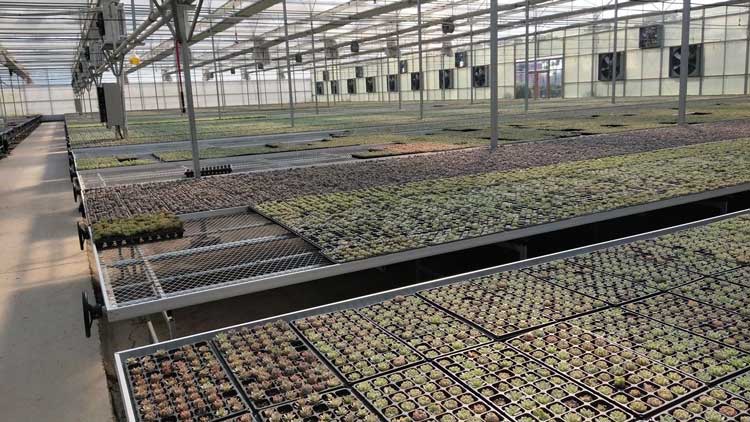
Characteristics and advantages and disadvantages of greenhouse rolling bench
Greenhouse rolling benches are a way to use the rise and fall of tides to adjust soil moisture and ventilation for seedling cultivation. The greenhouse rolling benches are generally built in places with good soil permeability and loose soil. The advantage is that they can make full use of the horizontal changes of tides to maintain the humidity and nutritional status of seedlings, thereby improving the survival rate and quality of seedlings. The construction cost of the greenhouse rolling bench is low and the water consumption is low. It is suitable for construction in some low-lying areas with rich water and soil resources.
The disadvantage of the greenhouse rolling bench is mainly limited by its static characteristics. Its seedling conditions are difficult to control and it is difficult to adjust the seedling conditions at different stages. For example, in the case of drought or insufficient rainfall, it is difficult to effectively adjust the rolling bench, and the seedlings are prone to drought or water shortage. At the same time, it is relatively difficult to prevent and control pests and diseases during the seedling cultivation process.