- +86-183-5022-2213
- [email protected]
Pallet racking systems provide an efficient, highly organized way to store palletized goods in warehouses. These racking systems optimize vertical space, increase storage density, and enable forklift accessibility — making them the backbone of modern pallet warehouse operations.
Pallet racking is designed to support large weights safely, accommodate various pallet sizes, and scale according to operational demands. Whether you operate a distribution center, 3PL warehouse, or high-bay storage facility, pallet racking is the foundational storage solution.
High Storage Density: Utilizing vertical space allows you to store more pallets per square meter.
Direct Handling: Forklifts can access most pallet locations directly, reducing handling time.
Scalable & Modular: Racking systems can be expanded, reconfigured, or upgraded as your business evolves.
Cost-Effective: Structurally efficient design and long service life lower the total cost of ownership.
Customizable for Your Needs: Choose beam types, frame heights, and accessories (such as wire mesh decking, steel decking, upright protector, pallet rack barriers) to match your SKU mix and warehouse operations.
Proven Safety: With standard compliance and robust locking / anchoring mechanisms, our pallet racking maintains stability and structural integrity.
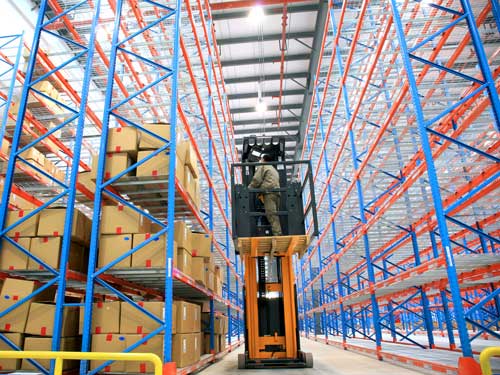
Pallet racking comes in a variety of configurations, suited to different operation types and warehouse layouts:

Selective pallet rack is the most common configuration, providing direct access to each pallet position. The selective pallet rack is ideal for high-SKU operations and quick turnaround.

Drive-in racking is a high-density racking system where forklifts drive directly into the structure. It is great for LIFO (drive-in) or FIFO (drive-through) inventory strategies.

Cantilever rack is designed for storing and handling various long or irregularly shaped goods, such ae metal tubing and profiles, plastic tubing, wood panels, and sheet metal.

Warehouse mezzanine floor system is an elevated floor/platform that install between the floor and the ceiling.

VNA racking optimizes space by reducing aisle width; it requires specialized forklifts to operate, but significantly improves storage efficiency.

Utilize gravity or spring-loaded carts, allowing pallets to be stored several deep with still fairly accessible handling and high density.
A typical pallet racking system includes:

Vertical supports with bracing, often made of high-strength steel.
Load-bearing beams that carry pallet weight, adjustable to various heights.
Wire mesh decking, steel decking, or particle board decking for case-picking or non-pallet loads.
Secure pallet rack beams to uprights and prevent unintended dislodgement.
Provide stability and secure the uprights to the floor.
Column guards, rack protectors, guiderails, netting, overspill bars, etc.
Trusted Quality: Manufactured to meet or exceed international standards.
Tailored Design: We customize configurations to your specific warehouse layout and business needs.
Scalable Infrastructure: Start small and grow your racking system with your business.
Safety-Focused: Full range of protection systems, locking mechanisms, and accessories.
Expert Support: From planning and design to installation and audits, our team provides end-to-end service.
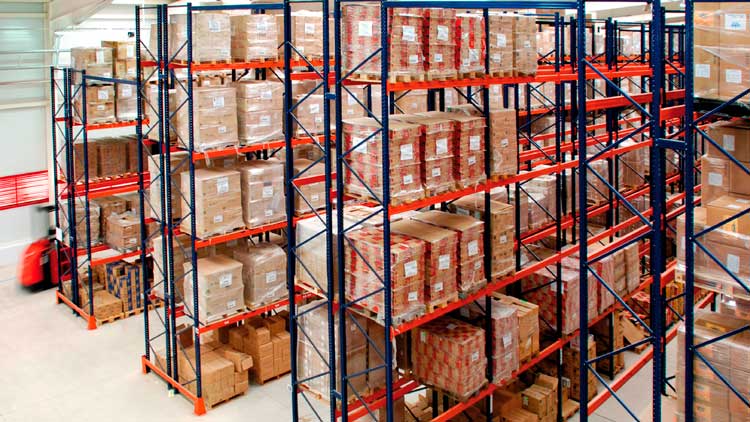
Maximize Warehouse Capacity with High-Performance Racking System
Trusted Quality: Manufactured to meet or exceed international standards.
Tailored Design: We customize configurations to your specific warehouse layout and business needs.
Scalable Infrastructure: Start small and grow your racking system with your business.
Safety-Focused: Full range of protection systems, locking mechanisms, and accessories.
Expert Support: From planning and design to installation and audits, our team provides end-to-end service.
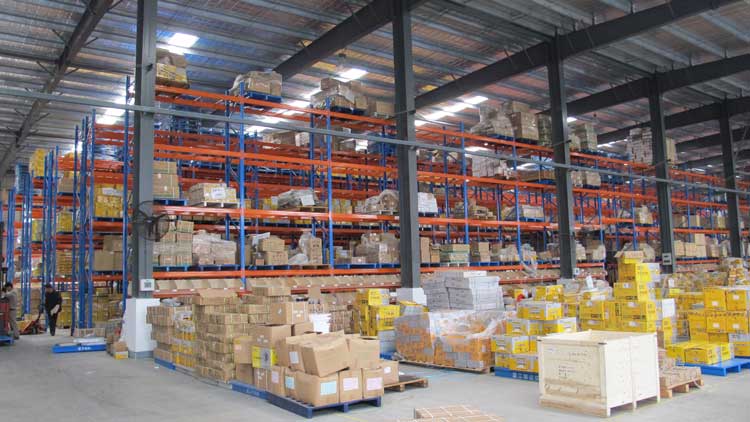
Optimized Layouts — Maximize your warehouse footprint while keeping operations efficient.
Operational Efficiency — Quick pallet access reduces handling times.
Adaptable to Change — As your business grows or evolves, you can reconfigure or expand your racking system.
Long-Term Return — Durable materials and standardized components mean lower CAPEX and maintenance costs over time.
Safety First — Comprehensive accessories and design options to minimize risk and protect people, inventory, and equipment.
Distribution Centers / DCs — For high-volume pallet flows, optimized for both storage and throughput.
3PL Warehouses — Flexible enough to support multi-client needs and changing SKU inventories.
Manufacturing Warehouses — Organize raw materials, WIP, and finished goods in structured pallet lanes.
Automated & High-Bay Facilities — Compatible with automated storage and retrieval systems (AS/RS), cranes, and high-reach vehicles.
Cold Storage & Cold Chain — Designed to perform in temperature-controlled environments with suitable coatings and finishes.


Conduct regular inspections of uprights, beams, anchors, and guards.
Check for signs of impact damage, deformation, or misalignment.
Re-torque anchor bolts and fasteners as needed.
Maintain clear aisle markings and load signage.
Train staff on proper loading practices and weight limits.
In seismic zones, reinforce frames and implement sway bracing or safety netting.
When selecting the right pallet racking solution for your warehouse, key factors to consider include: