
Pallet rack beams support pallets, but the space between them leaves smaller goods without a suitable resting surface. Cartons, bins and loose items may need additional support, particularly in areas used for manual picking.
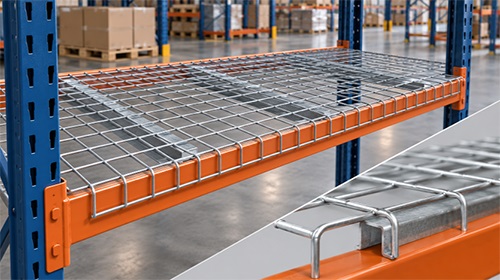
Wire mesh decking spans the front and rear rack beams, creating a supporting surface while allowing light, air and sprinkler water to pass through. Its usefulness depends on choosing a deck that fits the beams and is designed for the goods being stored. Deck dimensions, support channels and load distribution all matter.
1. Reducing the Risk of Goods Falling Through
Wire mesh decking helps prevent suitably sized goods from falling through the gap between rack beams. This is useful where a storage location holds cartons or containers rather than full pallets. However, the mesh opening must suit the items: small components may still fall through and need an appropriate bin or container.
For pallet storage, decking provides additional support within the rack opening. Pallets still need to be positioned according to the rack design. A mesh panel should not be treated as a way to make damaged pallets or poorly positioned loads acceptable.
Wire decking is also not a walking platform. Workers should never stand or climb on it to reach stock. RMI distinguishes storage loads from the concentrated load created by a person stepping onto a deck.
2. Making Stock Checks and Picking Easier
The open mesh allows light through the storage levels and gives workers a clearer view of goods than an opaque shelf surface. This can help when checking stock locations or looking for cartons left at the back of a picking level. It does not replace readable location labels or a consistent stock layout, but it makes visual checks easier.
In a mixed-use warehouse, decking designed for hand stacking can provide lower-level locations for cartons while upper levels remain allocated to pallet storage. This gives operators a defined picking surface instead of balancing cartons across open beams.
Flush-fit decks are commonly used for hand-stacking and order-picking applications. Their edge arrangement can help keep the beam face clear for labels. The actual deck and load rating must still be specified for that use.
3. Allowing Air, Light and Sprinkler Water Through
Unlike solid panels, wire mesh leaves openings between storage levels. Air and light can pass through the deck rather than being blocked by a continuous surface. This is a useful feature where visibility and air circulation matter.
The openings also allow overhead sprinkler water to pass through more readily than solid decking. However, this does not mean that any wire deck automatically meets a warehouse’s fire protection requirements. Deck selection should be reviewed alongside the stored goods, storage arrangement and sprinkler design.
Covering the mesh with boards or other continuous materials changes that open arrangement. If a solid surface is needed for particular goods, include it in the storage and fire protection review rather than adding it after installation.
4. Understanding What the Load Rating Means
A wire deck’s capacity is not determined by wire diameter alone. The mesh, reinforcing channels, deck depth and support conditions form a load-bearing assembly.
Many published ratings are based on a uniformly distributed load, meaning the weight is spread evenly over the deck surface. That rating should not be assumed to apply when the same weight rests on a small area.
For example, a machine resting on four small feet loads a deck differently from goods spread across its surface. Likewise, a container with narrow runners may concentrate weight along particular lines. These applications need the manufacturer to assess the contact points and load arrangement, not just the total weight.
Deck capacity and rack capacity must also be checked separately. Adding a stronger deck does not increase the approved capacity of the beams, uprights or complete rack system.
5. Matching the Deck to the Rack Beams
Two decks with similar overall dimensions may have different edges or support channels. Before ordering replacements, check how the existing deck rests on the beams.
Waterfall decking has mesh edges that extend over and down the outside beam faces.
Flush-fit or instep decking sits within a compatible beam arrangement, leaving the outer beam face unobstructed.
The channel ends must also match the beam profile. A design intended for a step beam should not be assumed to fit a box or structural beam. Provide the supplier with beam dimensions, photographs or a section drawing so the support arrangement can be checked.
Follow the specified installation and securing method. A panel that appears to fit still needs the correct bearing and protection against displacement.
6. Checking Installation and Everyday Condition
Installation is often straightforward when the deck has been correctly specified. Before loading, confirm that panels are seated properly and that the required fasteners or retaining provisions are fitted. RMI recommends securing methods that prevent decks from shifting or falling between the beams.
Include decking in routine rack inspections. Look for bent channels, broken wires, damaged welds and panels that have moved out of position. Investigate visible deformation before returning a location to service.
Keep the approved loading arrangement clear to warehouse staff, especially where similar-looking decks have different capacities.
7. What to Prepare Before Requesting a Quote
A useful quotation starts with information about both the rack and the load. Prepare:
- Rack depth, beam length and beam profile.
- Required panel dimensions and quantity.
- Maximum load and how it contacts the deck.
- Pallet, carton or container dimensions.
- Mesh opening and finish requirements.
- Photographs or drawings of the existing installation.
For an Aceally enquiry, include these details with a brief description of the storage task. This gives the team a clearer basis for checking fit and discussing a suitable deck specification before production.