
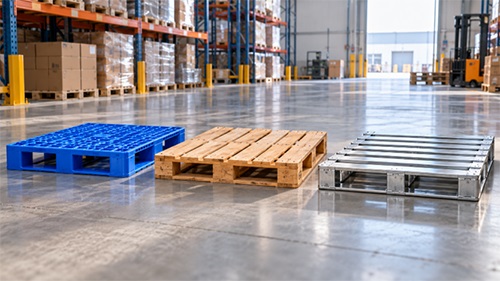
A standard pallet can weigh anywhere from 15 to over 150 lbs (7–68 kg) when empty, depending on its size, material and construction. Wooden pallets commonly weigh around 30–70 lbs (14–32 kg), plastic pallets range from approximately 15–70 lbs (7–32 kg), and steel pallets often weigh 70–150 lbs (32–68 kg) or more.
These are general estimates for common industrial pallet designs. Actual weights vary according to the manufacturer’s specifications.
Understanding pallet weight is important for shipping cost calculations, warehouse handling and pallet racking design. This guide compares standard pallet sizes, explains the differences between wood, plastic and steel pallets, and shows how pallet weight affects warehouse storage planning.
01 / Standard Pallet Sizes and Weights
Pallet dimensions vary across countries and industries. Three common sizes are widely encountered in international logistics and warehouse operations.
| Pallet Size | Common Market | Typical Application |
|---|---|---|
| 48 × 40 in (1219 × 1016 mm) | North America | Warehousing, retail distribution and logistics |
| 1200 × 800 mm | Europe | Euro pallet logistics and distribution |
| 1200 × 1000 mm | Asia and international logistics | Industrial storage and export handling |
Although pallets may share the same dimensions, their empty weights can differ significantly depending on the materials and structural design.
Typical Empty Pallet Weight by Material
| Material | Reference Size | Typical Empty Weight |
|---|---|---|
| Wooden Pallet | 48 × 40 inches | 30–70 lbs (14–32 kg) |
| Wooden Euro Pallet | 1200 × 800 mm | Approx. 55 lbs (25 kg) |
| Plastic Pallet | 48 × 40 inches | 15–70 lbs (7–32 kg) |
| Steel Pallet | 48 × 40 inches | 70–150 lbs (32–68 kg) or more |
Important: These ranges are indicative, not standardized weight specifications. Actual pallet weight should always be confirmed using the manufacturer’s product data.
02 / How Much Does a Wooden Pallet Weigh?
Wooden pallets are widely used in warehouses, manufacturing facilities and shipping operations because of their availability, relatively low initial cost and repairability.
TYPICAL 48 × 40-INCH WOODEN PALLET
30–70 lbs (14–32 kg)
Standard 48 × 40-Inch Wooden Pallets
The 48 × 40-inch pallet is commonly used in North American supply chains. Two common wooden pallet designs are:
Stringer Pallets
These pallets use longitudinal wooden members to support the deck boards. Their weight depends on the number and dimensions of the boards, wood species and overall construction.
Block Pallets
Block pallets use wooden blocks between the top and bottom deck structures. They can provide different handling access arrangements and load-support characteristics.
Neither design has one fixed weight. Individual specifications should be checked before use.
European Wooden Pallets
The standard EPAL 1 Euro pallet measures 1200 × 800 mm and has a nominal weight of approximately 25 kg (55 lbs).
It is commonly used in European logistics, warehouse storage and international distribution.
What Affects Wooden Pallet Weight?
Wood Species: Different timber types have different densities.
Moisture Content: Wet wood can weigh more than dry wood.
Deck Board Thickness: Thicker boards increase material weight.
Pallet Construction: Additional blocks, boards or reinforcement increase weight.
Repairs: Replacement components may change the original pallet weight.
For warehouse operations, the condition of wooden pallets is also important. Damaged boards or structural members can affect their suitability for handling and storage.
03 / How Much Does a Plastic Pallet Weigh?
Plastic pallets are commonly used in food processing, pharmaceutical distribution, logistics and other applications where moisture resistance and ease of cleaning are important.
TYPICAL 48 × 40-INCH PLASTIC PALLET
15–70 lbs (7–32 kg)
Lightweight Plastic Pallets
Lightweight plastic pallets are often used for export shipping and applications where reducing empty pallet weight is beneficial.
Some designs are nestable, allowing empty pallets to be stacked compactly for storage or return transportation.
However, lightweight construction does not necessarily make a pallet suitable for heavy loads or unsupported warehouse racking.
Heavy-Duty Plastic Pallets
Heavy-duty plastic pallets generally use stronger structural designs, thicker sections or additional reinforcement.
Certain models are specifically designed for use in pallet racking systems. These rackable plastic pallets may be heavier than lightweight alternatives because their construction must provide adequate support under the specified loading conditions.
Advantages of Plastic Pallets
✓ Moisture resistance
✓ Easy cleaning and maintenance
✓ Consistent manufactured dimensions
✓ No wooden splinters
✓ Suitable options for hygienic environments
✓ Reusable designs for closed-loop logistics
When selecting plastic pallets, buyers should check their static, dynamic and racking load ratings rather than relying on pallet weight alone.
04 / How Much Does a Steel Pallet Weigh?
Steel pallets are designed for industrial applications that may require high durability, repeated handling and specialized load-support configurations.
TYPICAL 48 × 40-INCH STEEL PALLET
70–150+ lbs (32–68+ kg)
However, steel pallet weight varies considerably according to the structural design.
Factors Affecting Steel Pallet Weight
Steel Thickness
Thicker steel sections generally increase pallet weight and may contribute to structural strength, depending on the overall design.
Frame Construction
Steel pallets may use welded frames, formed steel sections or other fabricated structural arrangements.
Reinforcement
Additional beams, supports and strengthening members increase the total weight.
Pallet Dimensions
Larger pallets generally require more material, although weight also depends on the structural configuration.
Typical Steel Pallet Applications
Steel pallets may be suitable for heavy machinery components, metal parts, manufacturing production lines, repeated material-handling operations and specialized industrial storage systems.
Although steel pallets are often heavier than wooden and plastic alternatives, they should not automatically be assumed to have a higher load capacity. The actual capacity depends on structural design, material specifications, support conditions and manufacturer testing or engineering verification.
05 / Wood vs. Plastic vs. Steel Pallets: Which Is Better?
Each pallet material has advantages and limitations. The most suitable choice depends on the products being handled, operating environment, budget and warehouse equipment.
| Comparison | Wooden Pallets | Plastic Pallets | Steel Pallets |
|---|---|---|---|
| Empty Weight | Medium | Light to medium | Medium to heavy |
| Initial Cost | Generally lower | Generally higher | Often higher |
| Moisture Resistance | Limited without treatment | Good | Depends on finish |
| Repairability | Often repairable | Design-dependent | Often repairable |
| Cleaning | More difficult | Generally easier | Depends on construction |
| Applications | General logistics | Food, pharma, distribution | Industrial storage |
Which Pallet Should You Choose?
Choose Wooden Pallets when initial cost, availability and conventional logistics compatibility are primary considerations.
Choose Plastic Pallets when hygiene, moisture resistance, dimensional consistency or repeated closed-loop handling are important.
Choose Steel Pallets when the application requires durable industrial construction and a suitable engineered load rating.
The best option is not necessarily the lightest or strongest pallet. It is the pallet that matches the handling equipment, goods, operating environment and storage system.
06 / Pallet Weight vs. Pallet Load Capacity
One common misunderstanding in warehouse operations is confusing pallet weight with pallet load capacity. These are two different measurements.
Pallet Weight (Tare Weight)
The weight of the empty pallet without any goods.
Pallet Load Capacity
The maximum load the pallet is rated to support under specified operating and support conditions.
A pallet weighing 25 kg does not automatically have a particular load capacity. Its capacity must be established from its design and manufacturer specifications.
Static, Dynamic and Racking Load Capacity
Static Load Capacity: The load a pallet can support while stationary under specified support conditions, commonly when resting on a suitable flat surface.
Dynamic Load Capacity: The load a pallet can support during handling and transportation under the manufacturer’s specified conditions.
Racking Load Capacity: The load a pallet can support when stored on a racking system under a specified support arrangement.
Safety Note: These ratings are not interchangeable. A pallet with a high static load capacity may not be suitable for storage across two pallet-racking beams without additional support.
How to Calculate Total Pallet Load Weight
When evaluating warehouse storage loads, the weight of both the pallet and its goods must be considered.
LOAD CALCULATION
Total Pallet Load Weight
= Empty Pallet Weight + Goods Weight
For example:
| Empty Wooden Pallet | 25 kg |
| Goods on Pallet | 1,000 kg |
| Total Pallet Load | 1,025 kg |
In this example, the total pallet load is 1,025 kg, not 1,000 kg. Packaging, containers and any additional load components must also be included where applicable.
07 / Why Pallet Weight Matters for Warehouse Racking
Pallet weight is not only a shipping consideration. It also plays a role in warehouse storage system design.
When planning pallet racking, engineers and warehouse operators need to understand the total weight, dimensions and support characteristics of the loaded pallets.
Selecting the Right Pallet Racking Capacity
A pallet racking system must be designed for the loads it will support.
For example, if two loaded pallets weighing 1,025 kg each are stored on the same beam level, their combined weight is:
EXAMPLE BEAM LEVEL LOAD
1,025 kg × 2 = 2,050 kg
The beam level must be suitable for the intended loading arrangement, and the overall rack structure must also be checked for the applicable loads and configuration.
Actual rack design should consider load distribution, upright capacity, beam capacity, connection details and relevant safety requirements.
Pallet Dimensions and Beam Configuration
Pallet dimensions affect how pallets are positioned and supported within a racking system.
✓ Pallet width and depth
✓ Pallet orientation
✓ Beam length
✓ Required loading clearances
✓ Pallet bottom-deck construction
✓ Load distribution
✓ Forklift operating requirements
A 48 × 40-inch pallet and a 1200 × 800 mm Euro pallet may require different rack configurations depending on their orientation and the handling equipment used.
Pallet Compatibility and Warehouse Safety
Not every pallet is suitable for every type of racking system.
Some lightweight plastic pallets may require additional support when placed in a rack. Similarly, damaged wooden pallets or improperly designed steel pallets may create storage and handling risks.
Warehouse operators should verify pallet condition, load ratings, support compatibility and the manufacturer’s recommendations before using pallets in elevated storage locations.
08 / Choosing the Right Pallet Racking with Aceally
At Aceally, we understand that an efficient warehouse storage system must accommodate more than the weight of the goods.
Pallet dimensions, pallet construction, total loaded weight, forklift access and available warehouse space all influence the selection of a suitable racking configuration.
We provide pallet racking solutions for warehouses, distribution centers and industrial storage facilities.
Depending on project requirements, our team can discuss:
| Pallet Dimensions | Rack configurations based on commonly used pallet sizes. |
| Load Requirements | Beam and upright configurations suited to intended pallet loads. |
| Warehouse Layout | Storage arrangements based on available space and operational requirements. |
| Handling Equipment | Considerations for forklift access and aisle arrangements. |
| Custom Configurations | Racking dimensions and storage layouts tailored to project needs. |
Whether your operation uses wooden, plastic or steel pallets, selecting the correct pallet racking system requires a clear understanding of both pallet characteristics and total storage loads.
YOUR WAREHOUSE. OUR SOLUTION.
Planning a New Warehouse Storage Project?
Share your pallet dimensions, total loaded pallet weight, warehouse layout and handling equipment requirements with the Aceally team.
We can help you explore a suitable pallet racking configuration for your storage operation.
Understanding how much a pallet weighs is the first step. Choosing a storage system that safely supports your loaded pallets is what makes the difference in long-term warehouse operations.