
Warehouse operators across the Middle East face growing pressure to use available storage space more efficiently. In major logistics hubs such as Dubai, Riyadh, and Doha, warehouse expansion can be costly, and existing facilities may have limited room for additional pallet storage.
Very Narrow Aisle (VNA) Racking offers an effective way to increase pallet storage density without necessarily expanding a warehouse’s footprint. By combining high-bay selective pallet racking with specialized narrow-aisle handling equipment, VNA systems can help businesses improve space utilization while maintaining direct access to individual pallets.
Here are four reasons why VNA racking is worth considering for warehouses in the Middle East.
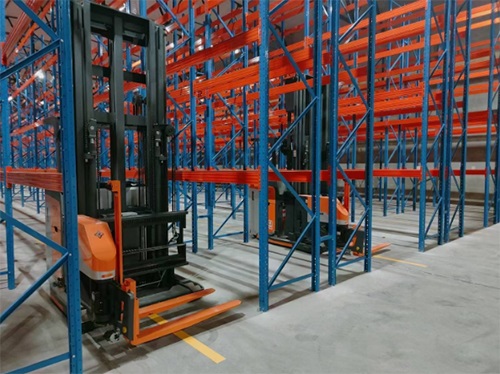
1. Maximize Storage Capacity in Limited Warehouse Space
Warehouse floor space is a valuable resource, particularly in established industrial and logistics districts.
Conventional selective pallet racking often requires wider operating aisles for standard forklifts. These aisles occupy floor area that could otherwise accommodate additional pallet positions.
VNA racking reduces the space allocated to forklift aisles by using specialized handling equipment designed to operate in much narrower passages.
This allows warehouse operators to install more racking rows within the same building footprint, potentially increasing pallet storage capacity without constructing a new facility.
The actual improvement depends on the existing warehouse layout, pallet dimensions, clear height, and selected handling equipment.
For businesses facing high expansion costs, VNA racking can be a practical way to make better use of existing warehouse space.
2. Upgrade Existing Warehouses Without Major Expansion
Many warehouses in the Middle East operate within established industrial buildings where physical expansion may be expensive or impractical.
VNA racking can offer an alternative by making more efficient use of both horizontal floor space and available vertical clearance.
Its high-bay storage arrangement allows businesses to accommodate more pallet positions within an appropriately designed warehouse layout.
However, a successful VNA installation requires careful evaluation of several factors:
- Floor flatness and load-bearing capacity
- Available warehouse clear height
- Building columns and structural obstructions
- Fire protection and emergency access requirements
- Compatibility with VNA forklifts and aisle guidance systems
Depending on the existing facility, floor improvements or other modifications may be necessary.
With proper engineering and layout planning, VNA racking can support warehouse modernization without requiring an entirely new building.
3. Support Efficient Pallet Access and Inventory Management
Warehouses serving import distribution, automotive parts, consumer goods, and wholesale businesses often handle a wide variety of palletized products.
For these operations, storage density is important, but so is the ability to access individual pallets without relocating other loads.
Unlike some high-density storage systems that restrict direct access, VNA racking generally provides access to every pallet position.
This makes it suitable for operations managing multiple SKUs, mixed inventory, and regular pallet retrieval.
When combined with appropriate warehouse management processes and VNA handling equipment, the system can support organized inventory control and efficient pallet movements.
However, overall handling performance depends on equipment selection, travel distances, order profiles, and operational planning. VNA systems should therefore be evaluated based on both storage capacity and throughput requirements.
4. Adapt Racking Design to Middle East Warehouse Conditions
Warehouses across the Middle East operate under different environmental conditions. Some facilities are fully climate-controlled, while others may experience high temperatures, airborne dust, or greater humidity in coastal locations.
These conditions should be considered during racking design and equipment selection.
For VNA installations, important considerations include:
- Appropriate steel specifications and structural design
- Suitable surface finishes for the operating environment
- Regular inspection and maintenance procedures
- Dust control and housekeeping
- Operating conditions for specialized VNA forklifts
Protective coatings can help reduce corrosion risks where appropriate, while regular maintenance supports the long-term condition of the storage system.
Because VNA systems operate with limited aisle clearance, maintaining suitable floor conditions and reliable handling equipment is especially important.
A properly specified system can provide dependable pallet storage while supporting long-term warehouse operations.
What Should You Consider Before Choosing VNA Racking?
Although VNA racking offers significant space-saving potential, it is not automatically the best solution for every warehouse.
Before selecting a system, businesses should evaluate:
Warehouse Dimensions: Building length, width, clear height, column positions, and available floor space.
Pallet Specifications: Pallet dimensions, load weights, maximum load heights, and required storage capacity.
Handling Equipment: VNA forklift type, operating aisle requirements, lift height, and guidance method.
Floor Conditions: Flatness, levelness, and structural capacity suitable for the selected equipment.
Operational Requirements: Daily pallet movements, SKU quantities, inventory turnover, and required picking efficiency.
Safety and Compliance: Applicable local building, fire safety, and warehouse operating requirements.
A professional warehouse layout assessment can help determine whether VNA racking will deliver a meaningful improvement over conventional selective pallet racking.
Conclusion
VNA racking can be an effective storage solution for Middle East warehouses seeking to increase pallet capacity while making better use of existing floor space.
Its combination of narrow operating aisles, high-bay storage, and direct pallet accessibility makes it particularly relevant to facilities managing diverse palletized inventory.
However, successful implementation depends on more than rack design alone. Floor conditions, specialized handling equipment, warehouse layout, and operational requirements must all be considered.
Planning a VNA racking project in Dubai, Saudi Arabia, Qatar, or elsewhere in the Middle East?
Contact Aceally to discuss your warehouse dimensions, pallet specifications, and storage requirements. Our team can review your project information and discuss suitable racking configurations.