
In terms of picking methods, storage racks can be divided into two types: manual picking shelves and mechanical picking racks. Manual picking shelves are the most common laminate shelves. Mechanical picking is to store the goods on pallets first, and then use forklifts to access the pallets. Therefore, mechanical picking racks can be collectively referred to as pallet racks.
Breaking it down further, pallet racks are actually divided into many types. Different types of pallet racks have different space utilization, cargo picking, storage and retrieval efficiency, etc. Let’s take a look at some of the most common pallet racking.

1. Heavy Duty Pallet Racks
Heavy-duty racks, also called beam racks, are the simplest, most common, and most widely used pallet racks. The structure of heavy-duty pallet racks is composed of beams and columns. According to storage needs, it can also be used with steel laminates, partitions, metal back nets, oil drum racks, etc. to meet the needs of storing different goods. The advantages of heavy-duty pallet racks include large carrying capacity (more than 500KG), 100% rack selectability, wide range of applications, and suitable for most products and warehouses. Heavy-duty pallet racks have simple structures, are easy to disassemble and assemble, and have low costs. The disadvantage is that the space utilization rate is average, and it is not suitable for warehouses that want to improve space utilization rate.

2. Drive Through Racks
Drive through racks, also called drive-in racks, are composed of uprights, diagonal braces, horizontal braces, back pulls, top pulls, top beams, partition braces, double corbels, hanging boards, single corbels, and foot guards. , guide rails, etc. Compared with heavy-duty racks, drive through racks do not need to reserve forklift channels. Forklifts can drive directly into the racks to store and pick up goods, maximizing space utilization and doubling the inventory compared to heavy-duty racks. Especially Suitable for storage of large goods with small variety and large quantity. The disadvantage of drive through racks is that goods must follow the principle of first in, last out, and cannot meet warehouses with high picking requirements. Moreover, their stability is the weakest among all heavy-duty racks, so their depth is generally 7 cargo spaces and the height is not If it exceeds 10m, a tightening device must be added to the system to enhance the overall stability.

3. Very Narrow Aisle Racks
Very narrow aisle racks are also called narrow lane racks. As the name suggests, the forklift transport channels of very narrow aisle racks are narrower (about 1.6-2m) than heavy-duty racks, which can improve warehouse space utilization. The overall structure of VNA racks is the same as that of heavy-duty racks. The difference is that the guide rails of a “three-way stacking forklift” are installed on the rack floor. The reserved channel for forklifts of very narrow aisle racks is only slightly larger than the width of pallet goods. Compared with heavy-duty racks, it not only retains the advantage of 100% pickability of goods, but also improves space utilization. For warehouses that want to improve space utilization, is a good choice. The disadvantage of very narrow aisle racking is that the supporting three-way stacking forklift is relatively expensive, and because the aisle is narrow, the technical requirements for the staff who drive the forklift are relatively high.

4. Double Deep Racks
Double deep racks, also called double-depth racks, have the same main structure as heavy-duty racks. The difference is that the heavy-duty racks are designed to be stored in two rows side by side. The advantage of this design is that it reduces the forklift aisle space and each storage line can store goods. With more than double the number of pallets, the space utilization rate is improved compared to heavy-duty racks. The floor utilization rate can reach 42%, but the picking rate of goods is also reduced, only 50%. Double deep racking must be equipped with a specialized scissor forklift. Double deep racks are suitable for warehouses that want to improve space utilization and can double the amount of inventory compared to heavy-duty racks.
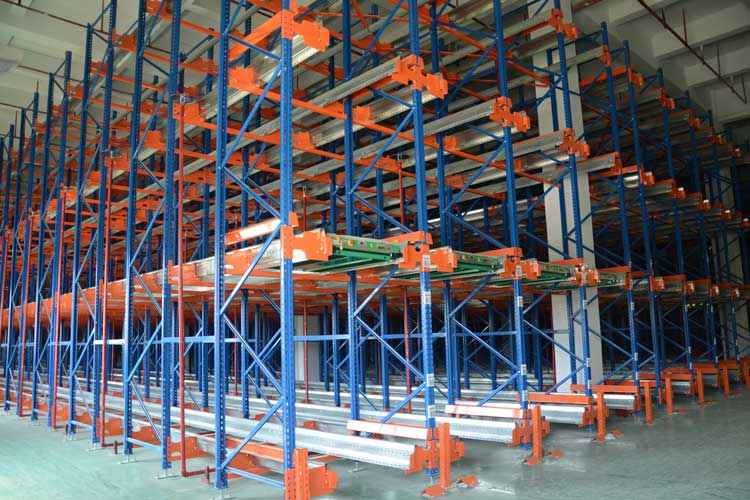
5. Radio Shuttle Racks
Radio shuttle racks are high-density storage racks. Like through racks, they do not require a forklift passage. Radio shuttle racking consists of shelves and shuttles. Compared with heavy-duty shelves, it is a high-density storage, the warehouse utilization rate is improved, and the space utilization rate reaches more than 80%. Compared with the through-type shelves, its operation method is flexible. The access of goods can be either first-in, first-out or first-in-last-out. At the same time, the overall stability of the radio shuttle racks is also greatly improved. The forklift does not need to enter the radio shuttle rack channel, which not only reduces the collision between the shelf and the forklift, but also improves safety and productivity. Shuttle vehicle storage and retrieval also improves work efficiency and greatly reduces operation waiting time. Radio shuttle racks are particularly suitable for cold storage, small varieties and large quantities, first-in-first-out, and increased storage capacity.
The above are the most common pallet racks. Warehouse racks, like other products, are constantly being updated and upgraded to meet the needs of different customers. When choosing, you can choose the storage solution that best suits your warehouse based on your warehouse, goods, access methods, etc. Of course, it is best to choose a professional shelf storage manufacturer to help you design it.