
When you run a warehouse, one of the biggest decisions you will make is choosing the right pallet racking system. The right choice can help you use your warehouse space more efficiently and make daily picking and storage easier. The wrong choice can lead to wasted space, slower operations, and unnecessary costs.
Two of the most widely used options are Selective Pallet Racking and Drive-In Racking. They serve different storage needs, so the best choice depends on your products, inventory flow, available space, and handling equipment.
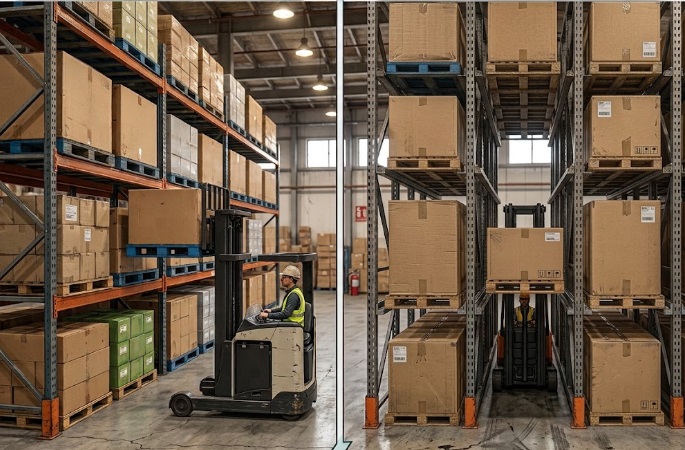
What Is Selective Pallet Racking?
Selective pallet racking is one of the most common pallet storage systems used in warehouses. Each pallet is stored on its own pair of beams, allowing forklift operators to access individual pallets directly without moving other pallets.
This makes selective racking a practical choice for warehouses that handle many different products or need frequent access to individual pallets.
warehouses with many SKUs, different product turnover rates, and frequent picking requirements.
Advantages
- Direct access to every pallet
- Fast and easy pallet picking
- Adjustable beam levels for different pallet heights
- Flexible for warehouses with changing inventory
- Suitable for FIFO or LIFO inventory management
Disadvantages
- Requires more forklift aisles
- Lower storage density than high-density systems such as drive-in racking
- More floor space is used for access aisles
What Is Drive-In Racking?
Drive-in racking is a high-density pallet storage system designed to maximize storage capacity within a limited warehouse footprint. Instead of providing a forklift aisle between every rack row, the system uses deep storage lanes.
A forklift can drive directly into the rack lane to place or retrieve pallets. Because pallets are generally loaded and retrieved from the same side, drive-in racking is normally operated on a LIFO (last-in, first-out) basis.
Warehouses that store large quantities of the same or similar products and do not require frequent access to individual pallets.
Common applications include cold storage, food and beverage warehouses, and bulk storage operations.
Advantages
- High storage density
- Fewer aisles are required
- More pallet positions can fit within the same warehouse footprint
- Efficient for storing large quantities of similar products
- Lower space cost per pallet position in high-density applications
Disadvantages
- Individual pallets are not all directly accessible
- Generally operates on a LIFO basis
- Less suitable for warehouses with many different SKUs
- Forklift operators need to work carefully inside storage lanes
- Pallet rotation is less flexible than with selective racking
Selective vs Drive-In Pallet Racking: Quick Comparison
| Feature | Selective Pallet Racking | Drive-In Racking |
|---|---|---|
| Pallet access | Direct access to every pallet | Limited access within each storage lane |
| Storage density | Moderate | High |
| Inventory flow | FIFO or LIFO | Generally LIFO |
| SKU variety | Suitable for many SKUs | Best for fewer SKUs in larger quantities |
| Best for | Frequent picking and varied inventory | Bulk storage of similar products |
| Forklift access | Forklift operates in aisles | Forklift enters storage lanes |
| Space efficiency | More space required for aisles | Fewer aisles required |
| Pallet rotation | Easy | Less flexible |
| Picking flexibility | High | Lower |
| Typical applications | Distribution, retail, e-commerce, spare parts | Cold storage, food, beverage, bulk storage |
How to Choose the Right Pallet Racking System
The right system depends less on the rack itself and more on how your warehouse operates. Consider these factors before making a decision.
1. How Many Different Products Do You Store?
If you have hundreds or thousands of SKUs, selective pallet racking is usually the more practical option. Each pallet can be accessed independently, making it easier to manage varied inventory.
If you store only a few products but keep large quantities of each, drive-in racking can provide much higher storage density.
2. How Fast Do Your Products Move?
For warehouses with frequent picking and high inventory turnover, selective racking provides faster and more convenient pallet access.
For slower-moving inventory that is stored in large quantities, drive-in racking can make better use of available warehouse space.
3. Do You Need FIFO or LIFO?
Inventory rotation is another important consideration.
If products need to be rotated on a FIFO (first-in, first-out) basis, selective racking provides direct access to individual pallets and makes stock management easier.
If LIFO is acceptable, drive-in racking can be a good choice because pallets are normally loaded and retrieved from the same side of the storage lane.
4. How Much Warehouse Space Do You Have?
If floor space is limited and storage density is a major priority, drive-in racking can reduce the amount of space required for forklift aisles and increase the number of pallet positions within the available footprint.
If accessibility and picking flexibility are more important than maximum density, selective racking is generally the better choice.
5. What Forklift Do You Use?
Your forklift dimensions and operating requirements should also be considered during rack design.
Selective racking typically provides straightforward aisle access for suitable counterbalance or reach trucks. Drive-in systems require a forklift that is compatible with the width, height, and depth of the rack lanes.
The rack system and forklift should therefore be considered together during the warehouse planning stage.
Selective or Drive-In: Which One Is Right for You?
There is no single pallet racking system that works best for every warehouse.
Choose Selective Pallet Racking If You:
- Store many different SKUs
- Need direct access to individual pallets
- Have frequent picking requirements
- Need flexible inventory management
- Prefer easy FIFO management
Choose Drive-In Racking If You:
- Store large quantities of the same or similar products
- Need to maximize storage density
- Have limited warehouse floor space
- Have relatively low inventory turnover
- Can operate with LIFO inventory flow
The key is to balance storage density, pallet accessibility, inventory turnover, SKU variety, and warehouse space rather than choosing a system based on storage capacity alone.
Need Help Choosing the Right Pallet Racking System?
The right configuration depends on factors such as pallet size and weight, the number of SKUs, inventory turnover, warehouse dimensions, required storage capacity, and forklift type.
Aceally can help evaluate these requirements and recommend a pallet racking solution based on your warehouse layout and storage needs, whether you require the flexibility of selective pallet racking or the high-density storage of drive-in racking.