
What Is a Radio Shuttle Racking System?
The Radio Shuttle Racking System—often referred to as a Pallet Shuttle System—is a semi-automated, high-density pallet storage solution. Instead of having forklifts drive deep into storage lanes, the system uses an electric shuttle cart that runs along rails installed within deep storage channels.
The forklift only places pallets at the channel entrance; the shuttle then transports the pallet to its designated storage position.
This “division of labor” between forklifts and the shuttle is the core of the system’s efficiency and safety.
Components and Basic Working Principle
✔ Key Components
1. Racking Structure + Rail System
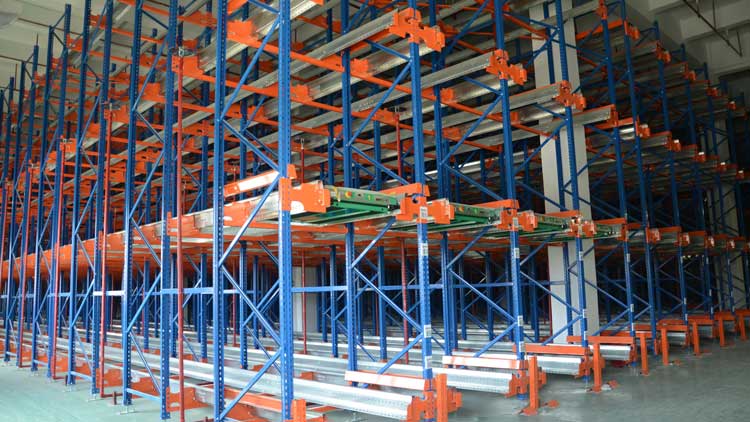
Heavy-duty uprights and beams form the main rack. Steel guide rails are installed at the bottom or at each level of the deep lanes to serve as tracks for shuttle operation.

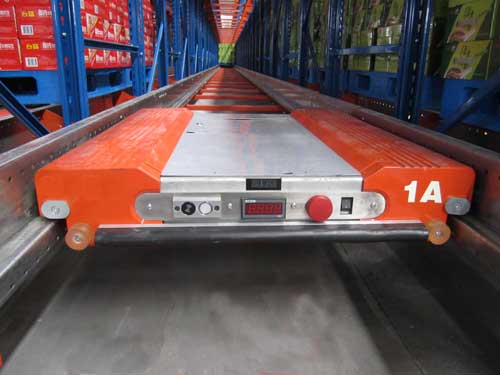
2. Radio Shuttle Cart
A battery-powered electric shuttle equipped with wheels, a lifting platform, and onboard sensors. It receives commands via remote control or WMS/WCS and handles pallet transport inside the lane.
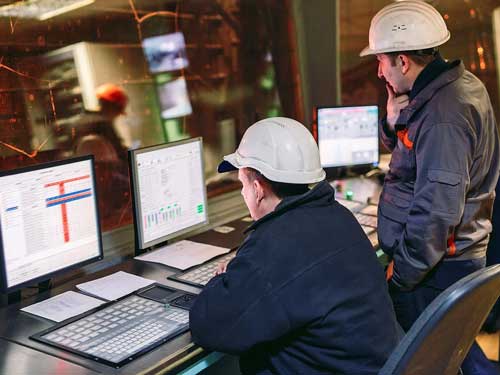
3. Control System / Operator Interface
Shuttles are typically controlled via a tablet or wireless remote. Some systems integrate directly with WMS to manage inventory, assign channels, and coordinate tasks.
🔄 How the Workflow Operates
A forklift places a pallet at the entrance of the lane.
The operator sends a command, and the shuttle lifts/supports the pallet and carries it into the lane.
The shuttle positions the pallet at the next available space and returns to the front for the next task.
For retrieval, the shuttle transports the selected pallet back to the lane entrance, where the forklift removes it—without entering the channel.
This workflow automates all internal lane movements and keeps forklift activity limited to the outside of the channel—greatly improving efficiency and minimizing risk.
Radio Shuttle vs. Traditional Racking Systems
| Feature / System | Selective Pallet Racking | Drive-In / Drive-Through Racking | Radio Shuttle Racking |
|---|---|---|---|
| Number of Aisles / Forklift Access | Many wide aisles required | Fewer aisles | Minimal aisles — forklifts stay outside the lanes |
| Storage Density | Medium | High | Very high (30–80% greater space utilization) |
| Pallet Handling Speed | Slow | Medium | Fast — semi-automated, reduced handling time |
| Safety | Lower (forklifts inside lanes) | Medium risk | High — forklifts never enter lanes |
| SKU Flexibility | High | Low | Medium — optimized for bulk, deep-lane storage |
Summary: Radio Shuttle systems excel in environments requiring high density, deep-lane storage, reduced forklift activity, and enhanced safety and efficiency.
Why More Warehouses Are Choosing Radio Shuttle Systems
📦 1. High Storage Density & Maximum Space Utilization
By reducing the number of aisles and enabling deep storage lanes, radio shuttle systems can increase warehouse utilization by 1.5–2× compared to conventional pallet racking.
This is especially valuable for:
- Urban warehouses with high land costs
- Cold storage facilities
- Distribution centers and logistics hubs
⏱️ 2. Higher Throughput & Reduced Labor Requirements
The shuttle handles all in-lane pallet movements, minimizing forklift travel time and eliminating complex maneuvering inside narrow lanes.
Forklifts can work on multiple lanes simultaneously while shuttles operate in the background—enabling parallel workflows and significantly improving throughput.
🔒 3. Improved Safety & Less Rack / Product Damage
Drive-in systems often suffer from rack collisions due to forklift entry.
Radio Shuttle racking eliminates most of these risks:
- Forklifts stay outside the lanes
- Less risk of hitting racks or goods
- More stable rack structure
- Better separation of pedestrian and vehicle movement
🔄 4. Supports Both FIFO & LIFO Inventory Strategies
The system easily switches between:
- FIFO (First-In First-Out) — ideal for perishables and SKU rotation
- LIFO (Last-In First-Out) — good for batch storage and repetitive operations
Each channel can store a different SKU, making it suitable for batch management and medium-frequency access.
🔧 5. Flexible, Scalable, and Cost-Effective Automation
Compared to fully automated stacker-crane AS/RS systems, Radio Shuttle systems are:
- More affordable
- Simpler to install
- Easier to expand
Storage capacity can be scaled by:
- Adding more shuttles
- Extending lane depth
- Increasing rack height
This makes it a practical mid-automation solution for many warehouses.
Typical Applications
- Cold storage / cold chain logistics — reduce forklift time inside low-temperature zones, lower energy use
- High-density bulk storage — ideal for food, beverages, FMCG, chemicals, raw materials
- Distribution centers / 3PL logistics — handle high pallet volumes and frequent inbound/outbound operations
- Buffer storage / seasonal inventory — perfect for predictable, high-volume stock movements
Points to Note / Potential Limitations
- Lower access flexibility compared to selective racking
Not suitable for environments requiring immediate access to every pallet
- Higher initial investment compared with standard static racking
Shuttle hardware, rails, and controls add cost
- Dependent on batteries / electricity
Requires charging schedules and proper maintenance
- Not ideal for extremely high SKU variety
Works best with medium or low SKU counts and batch storage patterns
A Modern Storage Solution Balancing Efficiency, Capacity, and Safety
For warehouses seeking high storage density, maximum space utilization, reduced forklift operations, enhanced safety, and greater throughput, the Radio Shuttle Racking System is one of the most competitive solutions available.
By combining shuttle automation + rail systems + conventional forklifts, it strikes an ideal balance between automation and cost—making it a smart choice for industries such as cold chain, food, raw materials, bulk storage, and 3PL logistics.