
In modern warehousing and distribution, space is money. The more efficiently you use vertical and horizontal storage space, the more competitive your operation becomes. A well-designed pallet racking system is the backbone of efficient warehouse storage, helping businesses increase capacity, improve picking speed, and maintain safety compliance.
Whether you operate a manufacturing facility, distribution center, retail warehouse, or third-party logistics hub, choosing the right warehouse pallet rack solution directly impacts productivity and long-term costs. This complete guide explains everything you need to know — from types and dimensions to load capacity, installation, safety, and cost considerations.
What Is a Pallet Racking System?
A pallet racking system is an industrial storage solution designed to store palletized goods in vertical rows across multiple levels. Instead of stacking products directly on the floor, pallets are supported by horizontal beams attached to vertical frames, creating organized, accessible storage lanes.
Core Purpose of Pallet Racking
- Maximize vertical warehouse space
- Improve inventory organization
- Increase storage density
- Enhance forklift accessibility
- Improve operational safety
In large-scale operations, industrial pallet racking can increase storage capacity by 40%–100% compared to floor stacking.
Main Components of a Pallet Rack System
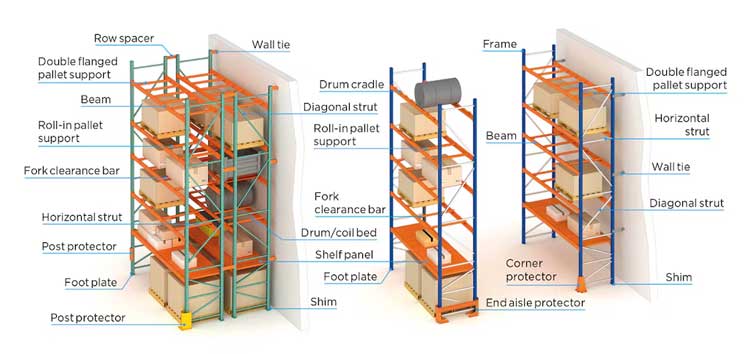
A typical pallet rack includes:
Vertical columns that bear the system’s weight. They consist of columns, diagonal bracing, and horizontal bracing.
2. Beams
Horizontal load-supporting members that hold pallets. Beam capacity depends on length and steel thickness.
3. Decking (Optional)
- Wire mesh decking
- Steel panels
- Pallet supports
These enhance safety and load distribution.
4. Base Plates & Anchors
Secure the system to the concrete floor, preventing tipping or shifting.
- Column protectors
- Row spacers
- Safety bars
- Rack guards
Each component contributes to structural integrity and safety compliance.
Types of Pallet Racking Systems
Choosing the right type of warehouse racking depends on inventory turnover, SKU variety, and available space.
The most common pallet racking system worldwide.
Features:
- Direct access to every pallet
- Compatible with most forklifts
- Cost-effective
Selective Pallet Racking is best for warehouses with high SKU variety and moderate turnover.
2. Drive-In / Drive-Through Racking
High-density storage where forklifts enter the rack structure.
Features:
- Fewer aisles
- Higher storage density
- LIFO (Drive-In) or FIFO (Drive-Through)
Drive-In Racking is best for Cold storage or bulk inventory with low SKU diversity.
Uses nested carts on inclined rails.
Features:
- Semi-dense storage
- LIFO inventory flow
- Faster retrieval than drive-in
Push Back Racking is best for Medium-turnover products.
Gravity-fed rollers move pallets forward automatically.
Features:
- FIFO inventory rotation
- High efficiency
- Reduced forklift travel time
Pallet Flow Racking is best for Perishable goods and high-volume distribution.
Designed for long, bulky items.
Best for:
- Lumber
- Pipes
- Steel bars
- Furniture components
How to Choose the Right Pallet Racking System
Selecting the correct industrial pallet racking requires evaluating several factors.
1. Warehouse Dimensions
- Ceiling height
- Floor load capacity
- Column spacing
2. Inventory Characteristics
- SKU quantity
- Pallet size variation
- Inventory turnover rate
3. Handling Equipment
- Counterbalance forklifts
- Reach trucks
- VNA equipment
4. Storage Density Requirements
If maximizing space is the top priority, high-density systems may be ideal.
5. Budget & Expansion Plans
Plan for future growth to avoid costly reconfiguration.
A professional layout design service can significantly optimize warehouse flow and long-term scalability.
Standard Pallet Rack Dimensions
Understanding pallet rack dimensions helps ensure compatibility with your warehouse layout.
Frame Heights
8 ft (2.4m)
12 ft (3.6m)
16 ft (4.8m)
20+ ft for high-bay systems
Frame Depth
36″
42″
48″
Beam Length
96″
108″
144″
Custom dimensions are available depending on project requirements.
Pallet Rack Load Capacity
One of the most critical considerations in any pallet racking system is load capacity.
Load capacity depends on:
- Beam length
- Beam thickness
- Steel grade
- Upright frame design
- Anchor strength
Simplified Load Principle
Beam capacity is calculated based on:
- Uniformly distributed load
- Deflection limits (commonly L/180 standard)
Never exceed manufacturer-rated capacity. Overloading is a primary cause of structural failure.
Pallet Rack Installation Guide
Proper installation ensures safety and long-term durability.
Installation Steps:
1.Floor inspection
2.Layout marking
3.Frame assembly
4.Beam installation
5.Level adjustment
6.Anchoring
7.Final inspection
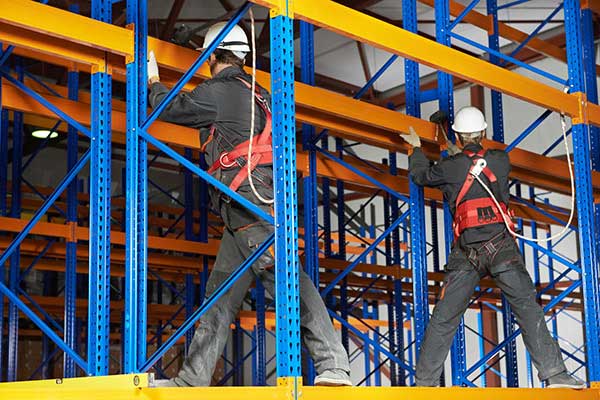
Anchoring Requirements
All pallet racks must be anchored to concrete floors using heavy-duty expansion anchors.
Clearance Standards
- Minimum aisle width
- Overhead sprinkler clearance
- Flue space requirements
Improper installation significantly increases collapse risk.
Pallet Rack Safety Requirements
Warehouse pallet racks must comply with safety standards and regular inspection practices.
Safety Best Practices
- Conduct annual rack inspections
- Replace damaged components immediately
- Install column protectors
- Use load signage
- Train forklift operators
Common Safety Risks
- Forklift impact damage
- Beam dislodgement
- Overloading
- Missing anchor
A damaged rack compromises the entire system.
Common Pallet Racking Problems & Solutions
1. Rack Leaning
Cause: Uneven flooring or anchor failure
Solution: Re-level and re-anchor immediately
2. Beam Deflection
Cause: Overloading
Solution: Verify load capacity rating
3. Frame Damage
Cause: Forklift collision
Solution: Replace affected upright sections
4. Corrosion
Cause: Humid or cold storage environments
Solution: Galvanized finish options
Regular inspection reduces operational risk and liability exposure.
Cost of Pallet Racking Systems
Pallet racking cost varies based on:
- System type
- Steel price fluctuations
- Custom dimensions
- Load capacity requirements
- Installation complexity
- Accessories & safety add-ons
Selective pallet racks are generally the most economical. High-density systems cost more but offer higher storage efficiency.
When evaluating cost, consider total lifecycle value — not just upfront price.
New vs Used Pallet Racking
New Racking
- Full structural integrity
- Warranty coverage
- Custom design flexibility
Used Racking
- Lower upfront cost
- Limited availability
- Potential hidden damage
For long-term operations, new pallet racking often delivers better ROI.
Benefits of Professional Pallet Rack Manufacturers
Choosing an experienced manufacturer provides:
- Engineering calculations
- Custom CAD layout design
- Load testing compliance
- Quality-controlled steel fabrication
- Project management support
- After-sales service
A tailored pallet racking system improves safety, efficiency, and long-term scalability.
Frequently Asked Questions (FAQ)
What is the standard pallet rack height?
How much weight can a pallet rack hold?
Do pallet racks need to be anchored?
How long do pallet racks last?
Can pallet racking be relocated?
How often should pallet racks be inspected?
In Summary
A well-designed pallet racking system is a strategic investment that directly influences warehouse efficiency, safety, and profitability. From selective pallet racks to high-density storage solutions, choosing the right configuration ensures your operation runs smoothly today and scales for tomorrow.
If you are planning a new warehouse, expanding capacity, or upgrading existing storage infrastructure, professional guidance can help you avoid costly mistakes.
Request a free layout design or quotation today and optimize your warehouse storage with a reliable pallet rack solution built for performance and durability.