
As a worker focused on logistics, warehousing, or industrial solutions, you understand the critical need for efficient storage. Pallet racking is the undisputed workhorse of modern warehouses and distribution centers. But how exactly does this essential system function? Let’s break down the mechanics and benefits.
The Core Principle: Turning Vertical Space into Accessible Storage
At its heart, pallet racking is a modular steel structure designed to store unitized loads (typically goods on pallets) safely and accessibly by maximizing your warehouse’s vertical cube. Unlike simple floor stacking, it creates organized levels, allowing direct access to individual pallets.
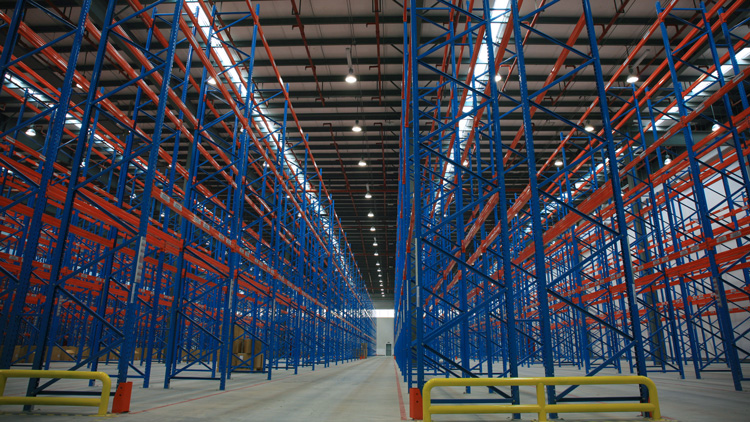
Key Components & How They Interact
- Pallet Rack Upright Frames (Vertical Columns):
Function: Form the vertical support structure. They are anchored securely to the warehouse floor.
Key Feature: Have precisely spaced holes or slots running vertically up their height.
How it Works: These holes serve as connection points for pallet rack beams, enabling you to adjust the height of each storage level.
- Pallet Rack Beams (Horizontal Supports):
Function: Create the actual shelf levels where pallets rest.
Key Feature: Have hooks or connectors at each end.
How it Works: The beam ends lock securely into the holes on the upright frames. A pair of pallet rack beams (front and rear) creates a single storage level within a “bay” (the space between two sets of uprights).
- Wire Mesh Decking or Pallet Supports (Optional but Highly Recommended):
Function: Provides a solid surface spanning the pallet rack beams.
How it Works: Wire mesh decking rests on the pallet rack beams, providing full support for the pallet and preventing small items from falling, thereby improving safety and helping to distribute the load evenly. Some systems rely solely on the pallet spanning the front and rear beams.
The Workflow: Storing and Retrieving Pallets
This warehouse racking system shines when paired with material handling equipment like forklifts or pallet jacks:
- Storing a Pallet:
A forklift picks up a loaded pallet.
The driver navigates to the designated location (e.g., Aisle 3, Bay 5, Level 2).
The driver lifts the pallet slightly above the height of the beam level.
The driver moves forward into the bay, positioning the pallet over the pallet rack beam or wire decking.
The driver carefully lowers the pallet onto the pallet rack beams/wire decking.
The forklift withdraws, leaving the pallet securely stored.
- Retrieving a Pallet:
The forklift positions itself in front of the target bay.
The driver lifts the forks to just below the level of the pallet to be retrieved.
The driver moves the forks into the pallet’s stringer openings.
The driver lifts the pallet slightly above the beam level.
The driver carefully withdraws the pallet from the bay.
The pallet is lowered and transported for use.
Why Pallet Racking is Essential for Your Operation
Maximizes Vertical Space: Drastically increases storage capacity compared to floor stacking alone.
Provides Selective Access: The most common type (Selective Racking) allows direct, immediate access to every single pallet. No need to move other pallets to reach the one you need (FIFO or LIFO possible).
Organizes Inventory: Creates a systematic, locatable system (Aisle-Bay-Level) for precise inventory management.
Enhances Safety: Properly engineered and installed racking safely supports heavy loads. Wire decking prevents falls and improves stability. Safety features like column guards add further protection.
Improves Efficiency: Speeds up both put-away and picking operations, boosting warehouse throughput.
Versatile & Scalable: Modular design allows for easy reconfiguration, expansion, or adaptation as your storage needs change.
Common Variations for Specific Needs
While selective racking is the standard, different warehouse racking types alter the “how” for density or access:
Drive-In/Drive-Thru Racking: Forklifts drive into the rack structure. Pallets rest on rails, stored multiple deep per level (High density, LIFO/FIFO).
Push-Back Racking: Pallets are stored on nested carts positioned on inclined rails. Removing one pallet allows the next to roll forward (Medium density, LIFO).
Pallet Flow Racking: Uses inclined roller tracks. Pallets are loaded high, flow by gravity to the picking face (High density, FIFO).
Double-Deep Racking: Stores pallets two deep per level. Requires a reach forklift to access the rear pallet (Higher density than selective, less selectivity).
Cantilever Racking: For long, bulky items. Uses arms projecting from a central column.
Critical Considerations for Safe & Effective Operation
Load Capacity: NEVER exceed the rated capacity (UDL – Uniformly Distributed Load) of beams and uprights.
Proper Installation: Must be level, plumb, securely bolted to the floor, and correctly braced.
Forklift Clearance: Adequate aisle width is paramount for safe maneuvering and pallet handling.
Pallet Compatibility: Beam length and spacing must match your pallet size and weight.
Regular Inspections: Implement a schedule to check for damage (e.g., from forklift impacts) and ensure structural integrity.
Repair damage immediately.
Safety Features: Use rack protectors (column guards), ensure beam locks are engaged, and enforce safe operating procedures.
In Conclusion
Pallet racking works by providing a robust, adaptable steel framework (uprights and beams) that transforms your vertical warehouse space into organized, easily accessible storage levels. Forklifts interact seamlessly with this structure to place and retrieve pallets efficiently.
By choosing the right type of racking and adhering strictly to safety and load guidelines, you unlock significant gains in storage capacity, operational efficiency, inventory control, and workplace safety – fundamental pillars for any successful warehousing or logistics operation. Investing in a well-designed pallet racking system is truly investing in the backbone of your storage infrastructure.