
Drive in pallet racking is a high-density storage system designed to maximize warehouse space utilization. This racking system operates on a last-in, first-out (LIFO) inventory management principle, making it particularly suitable for storing large quantities of similar products.
By eliminating multiple access aisles, drive in pallet racking significantly increases storage capacity within the same footprint compared to selective pallet racking. Businesses with high-volume, low-SKU operations frequently implement this solution to improve storage efficiency and reduce operational costs. The core advantage lies in its ability to utilize cubic space effectively, making it a fundamental component in modern warehouse design for specific inventory types.
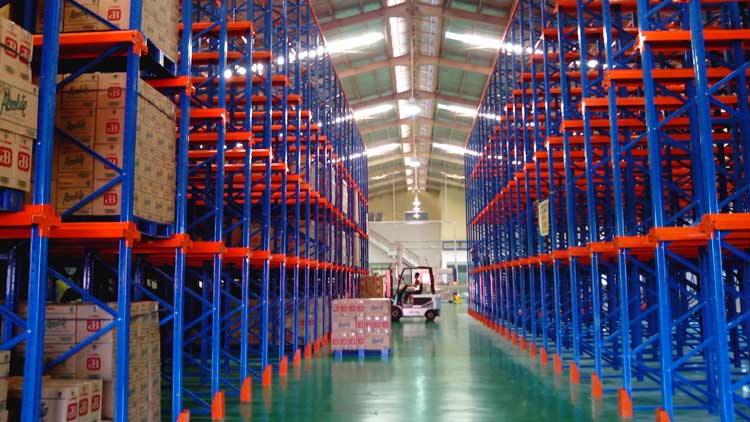
Components and Structural Design
The structural integrity of a drive in pallet racking system relies on its specific components. Understanding these parts is crucial for proper installation, operation, and safety.
- Upright Frames and Structural Bracing
Upright frames form the vertical support structure of the racking system. These are typically heavy-duty steel frames with robust bracing to withstand the impact from forklifts and the substantial load of stored pallets. The design includes guide channels for the rails that form the storage lanes, ensuring precise alignment and consistent load-bearing capacity throughout the racking system’s height.
- Rails and Pallet Support Beams
Unlike selective racking, drive in pallet racking systems use rails instead of beams to create continuous shelving within each lane. Pallets rest on these rails, which are installed at each storage level. The design allows forklifts to drive directly into the rack structure. The placement and strength of these rails are critical, as they must support the full weight of the palletized load and distribute the force from forklift entry and exit.
- Entry and Exit Configurations
A standard drive in racking system is configured for single-direction access, meaning forklifts enter and exit from the same aisle. For higher throughput requirements, a drive through racking configuration can be implemented, allowing entry from one side and exit from the opposite, facilitating a first-in, first-out (FIFO) inventory method. The entrance is reinforced to handle frequent contact and includes safety features to protect the overall structure.
- Operational Workflow and Suitability for Different Inventory Types
The operational process for drive in pallet racking is specialized and requires trained forklift operators. The workflow involves a forklift driving directly into the rack structure to place or retrieve a pallet from the available lane. This method demands precision and care to avoid damaging the racking or stored goods. It is ideally suited for homogeneous products with long-term storage needs, such as seasonal items or bulk raw materials. Industries like cold storage, food and beverage, and manufacturing commonly use this system to store products that are not date-sensitive or are part of a large batch.
Advantages and Considerations
The decision to implement a drive in pallet racking system comes with distinct benefits and important considerations.
- Maximizing Warehouse Storage Density
The most significant advantage is the dramatic increase in storage density. By reducing the number of access aisles to a minimum, the racking system can increase storage capacity by up to 75% compared to traditional selective racking. This makes it an excellent solution for warehouses where available space is a primary constraint and the cost per square foot is high.
- Cost-Effectiveness for Specific Inventory
For businesses storing large quantities of a limited number of SKUs, drive in pallet racking offers a cost-effective storage solution. The reduction in aisle space translates to lower real estate costs per pallet position. Furthermore, the racking system can be more economical than automated alternatives, providing a high-density option without a massive capital investment.
- Critical Safety and Operational Factors
A key consideration is the inherent LIFO inventory rotation. This makes the racking system less suitable for perishable goods or products with strict expiration dates unless a drive through (FIFO) design is used. Operator safety is paramount, as the process requires driving into a confined space. Strict safety protocols, experienced operators, and regular rack inspections are non-negotiable to prevent accidents and product damage. The racking system’s throughput speed is also generally lower than selective racking due to the deeper lane depths.
- Optimizing Warehouse Layout with Drive In Racking
Integrating drive in pallet racking into a warehouse layout requires careful planning. The layout must account for the single access aisle, the depth of the storage lanes, and the turning radius of the forklifts. It is often used in combination with other storage racking systems, such as having selective racking in the picking area and drive in racking in the bulk storage area. This hybrid approach allows a facility to balance high-density storage with faster access to a wider variety of SKUs, creating an optimized and efficient overall storage strategy.
Common Questions About Drive In Pallet Racking
- What is the main difference between drive in and drive through racking?
Drive in pallet racking is a LIFO (Last-In, First-Out) system with access from a single aisle. Drive through racking is a FIFO (First-In, First-Out) system with access from both ends, allowing pallets to be loaded from one side and unloaded from the other.
- What type of forklift is required for drive in pallet racking?
Standard counterbalance forklifts are typically used. The forklift must have the appropriate lifting height, capacity, and, most importantly, the operator must be specially trained to navigate the narrow lanes and operate safely within the confined rack structure.
- How many pallets deep can a drive in racking system be?
Drive in racking systems are commonly built between 3 to 10 pallets deep. The optimal depth depends on the inventory turnover rate, the total number of pallets per SKU, and the need to balance storage density with accessibility and throughput speed.
- Is drive in racking suitable for a cold storage facility?
Yes, drive in racking is often used in cold storage and freezer applications because maximizing storage density directly reduces the very high costs associated with cooling or freezing a large space. The high-density nature of the system makes it economically advantageous in these environments.
Optimize Warehouse Space and Enable Efficient Logistics
As you can see, drive-in pallet racking is a powerful solution for increasing storage density and reducing operating costs. However, every warehouse’s operational needs and cargo characteristics are unique, and choosing the most suitable warehouse racking system is key to maximizing your return on investment.
Are you looking for a professional solution to increase your warehouse’s storage capacity?
Our experienced team is at your service. From initial consultation and personalized solution design to professional installation and after-sales support, we’ll guide you every step of the way, ensuring your warehouse racking solution is safe, efficient, and cost-effective.
Act now and inject new momentum into your warehouse logistics!
Contact us today for a free warehouse assessment and a customized warehouse racking solution quote.
- Whatsapp/wechat/tell: +86-183-5022-2213
- Email: [email protected]